
Key socio-economic indicators for 2019
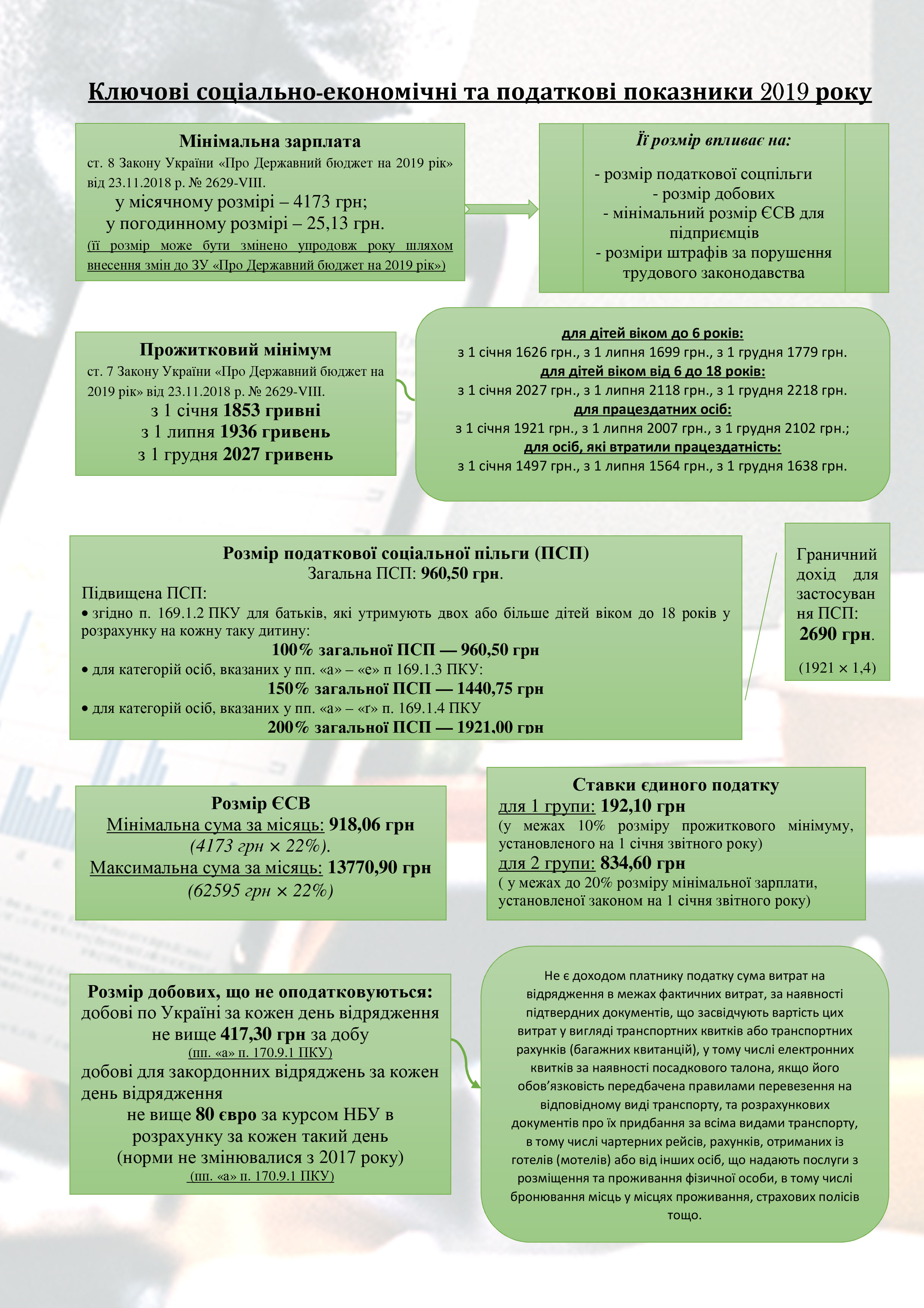
Major innovations in tax law in 2019
According to the changes specified in Law No. 2628, individual entrepreneurs pay ESW at a discount rate of 8.41% for workers with disabilities
The income of natural persons who have received income without the participation of tax agents and are obliged to submit a declaration of income for the reporting year, include:
— remuneration to persons employed by private individuals (gardeners, domestic workers, drivers, governesses, builders);
— from renting out their own movable or immovable property or having received income from the sale of such property;
— from the received investment assets, namely from the sale of securities and corporate rights, with the exception of the types of income specified in Art. 165 PKU;
— from written off overdue debt for which the limitation period of 1095 days (3 years) has expired;
— from written-off arrears under civil agreements, given that the amount is more than 50% of the monthly subsistence minimum set for an able-bodied person as of January 1 of the reporting year (UAH 960.5 in 2019);
— from the amount of debt written off or loan canceled or forgiven by financial institutions prior to the expiry of the statute of limitations and reported to the debtor, with the amount of such debt exceeding 25% of the minimum wage in the year established on January 1, 43 (reporting year) , 25 in 2019).
The declaration must be completed on the basis of the Book of accounting of income and expenses, completed on the basis of supporting documents
According to item 166.3.9 of the Tax Code, the tax rebate on the personal income tax is allowed to include the amount of the rent actually paid by the taxpayer having the status of internally displaced person. At the same time it is necessary to have a legally signed lease agreement, and there are restrictions on the amount of this tax rebate: it cannot exceed 30 calendar minimum wages (for 2019, UAH 125190), set for January 1, of the reporting year.
According to Art. 271.2 The GCC decisions of local councils on the regulatory monetary valuation of all land parcels, including those outside the settlement, should be published on the website of the local government until July 15, which precedes the budget period in which the regulatory monetary valuation of land is planned.
According to the provisions of Law No. 2628 of 01.07.2019, the total invoiced non-taxable value of parcels to natural persons is reduced from 150 to 100 euros. However, an amount of EUR 150 remains for unaccompanied luggage. It should be noted that the non-taxable VAT threshold for international postal and express shipments to legal entities and individual entrepreneurs also remains at the equivalent of 150 Euro.
The effect of VAT exemptions on medicines, coal, scrap metal, waste paper, electric vehicles is exempt Exempt from VAT operations:
- the supply, import and disposal of waste and scrap of ferrous and non-ferrous metals, as well as paper and paperboard for recycling (waste and scrap) by 1 January 2022;
- on import, first supply and delivery (transfer) of medicines, medical devices and medical equipment in the customs territory of Ukraine until December 31, 2020;
- to supply coal and / or enrichment products to the customs territory of Ukraine by January 1, 2022;
- the importation into the customs territory of Ukraine and the supply in the customs territory of Ukraine of vehicles equipped exclusively with electric motors by December 31, 2022
According to the changes of Art. 165.1.39 of the Tax Code , introduced by Law No. 2628, it is definitively determined that gifts are taxed at a value in excess of 25% of the minimum wage (in 2019, UAH 1043.25).
According to Art. 199 of the Tax Code and Law No. 2628 of 2019, VAT payers cannot stop applying or waiving tax exemptions. Thus, according to the results of 2019, which will be carried out in 2020, all VAT payers will recalculate their tax liabilities in accordance with the procedure specified in Article.199 of the Tax Code.
From 01.01.2019, services for renting and subletting land owned by the state or territorial community are exempt from VAT.
According to para. 1 tbsp. 56.3 PKUit is now possible to object to the results of the inspection by the inspecting authority that carried out the inspection within ten, not five, working days from the day following the day of receipt of the act of inspection by filing an objection and / or supporting documents. From ten to fifteen business days, the tax decision-making deadline for inspections has been increased. The tax notification decision is still made, taking into account the conclusion of the results of consideration of objections to the act of inspection and / or additional documents within three working days. to file a complaint with a higher-level supervisory authority in writing, taxpayers have the opportunity within 10 working (not calendar) days, which comes after the date of receipt of the tax notification-decision or other decision of the supervisory authority being appealed. The right to a documentary planned check of the taxpayer shall be granted only if it is not later than 10 calendar days before the day of the said check handed over to the receipt or sent by registered letter with the notification of service of a copy of the order on the documentary scheduled check and a written notice stating the date on which such review begins. At the same time, sending a registered letter with the relevant order requires proof (notification) of its delivery to the addressee. when, not later than 10 calendar days before the date of the said inspection, it was handed over to the receipt or sent by registered letter with a notification of service of a copy of the order for carrying out the documentary scheduled inspection and a written notice stating the date of the beginning of such inspection. At the same time, sending a registered letter with the relevant order requires proof (notification) of its delivery to the addressee. when, not later than 10 calendar days before the date of the said inspection, it was handed over to the receipt or sent by registered letter with a notification of service of a copy of the order for carrying out the documentary scheduled inspection and a written notice stating the date of the beginning of such inspection. At the same time, sending a registered letter with the relevant order requires proof (notification) of its delivery to the addressee.
Pursuant to the Law on Limited and Additional Liability Companies, which abolished the provisions of the Companies Act in the part of limited and additional liability companies, the deadline set aside for bringing the statutes of LLC and VAT into compliance with the requirements of the above law expires on 17.06.2019. In this case, the statutes that were registered prior to the adoption of the Law on Societies until 17.06.2018 shall remain in force for a period of one year, in accordance with the legislation before the entry into force of the new law, and If the societies do not amend the statutes during the year, such statutes will be effective. only to the extent that is not contrary to the law on Societies.
According to Mr. 212.1.15 NKUEntrepreneurs who sell ethyl and fuel alcohol will receive a separate status of excise duty payers and must not later than 3 days register in tax and pay excise tax on excess of sales of alcohol and fuel over the volume of its receipt. From 01.07.2019 the SEARP is transformed into a SEARPS, whereby the SEARPS will control the sales volumes not only of the taxpayer, but also of the individual excise duty of such a person, and in case of excess of the sales volume of a separate excise warehouse, an object of taxation will arise. The concept of excise warehouse has been expanded and the terms of equipment of such warehouses have been set by flowmeters and meters. starting on October 1, 2019, penalties of UAH 1 million will be applied to persons who have not registered the excise warehouse in SEARPS,
Eligibility for accelerated depreciation for machinery and equipment group 4 has been extended for another year if depreciation is calculated on a straight-line basis, ie for fixed assets commissioned in 2019.
From January 1, 2019, IFRS 16 «Lease» has come into force, and anyone keeping IFRS (International Standards) accounting must apply the new rules to accounting for operating leases with lessees. The lessee assesses and recognizes, at the date of the lease, an asset in the form of a right of use and, at the same time, a lease liability for the present value of the lease payments not yet made at that date. Lease payments are discounted using the easy-to-determine interest rate stipulated in the lease agreement, if such a rate cannot be determined, the additional borrowing rate is used. It should be noted that the depreciation differences provided for in Art. 138.1–138.3 PKU, leasehold transactions do not apply to leasehold assets. Also, the above changes do not apply to those entrepreneurs who keep records according to the NSFZ (national standards).
Topical issues of labor law
The employer must, on the day on which the employee actually commences to work or the day before, send a notification to the DFS authorities that the employee has been hired.
This message is sent when concluding:
— an indefinite employment contract;
— fixed-term employment contract (for a fixed term, agreed upon by the parties; at the time of performing certain work, with seasonal or temporary workers);
— contract.
According to Art. 265 Code of Labor Laws for the actual admission of an employee to work without an employment contract, registration of his not full time in the case of actual performance of the full time job or for payment of wages in the «envelope» employers in 2019 will pay thirty times the minimum wage (125 190 UAH), established by law at the time of detection of the violation, for each employee for whom the violation was committed. Also according to Art. 41 of the Code of Ukraine on Administrative Offenses of Ukraine arises administrative responsibility of the head of the enterprise from 8 500 UAH to 17 000 UAH for the actual leave of the employee without an employment contract.
In case of underemployment, it is necessary to base on the content of the order (order) on hiring, the standard form No. P-1 of which was approved by the order of the State Statistics Committee of 05.12.2008 No. 489 . This order is not a normative legal act, but the State Labor Committee recommends using the most typical forms approved by it, it should be noted that the courts often agree with it.
The part-time employment order shall specify: — the
length of the working week (number of working hours per week) and daily work;
-the number of working days per week;
— start and end of daily work and breaks.
In accordance with paragraph 3.1 of the Guidelines for the establishment of flexible working time regime, approved by the Ministry of Labor Order of 04.10.2006. No. 359 for an employee is determined by an individual part-time work schedule, which provides the following mandatory elements of working time:
— fixed time,
— shift time,
— break and rest time.
According to the provisions of the letter of the Ministry of Social Policy of December 22, 2017 No. 2960/0 / 107-17 / 284, in the case of part-time mode, payment is made in proportion to the hours worked, and individual working hours are not established.
The first stages of registration of an employee at work at home are generally accepted:
— the employee submits a passport or other identification document;
— submits a work book;
— if necessary, submit a document on education, specialty, qualification;
— submits a document on health status;
— concludes an employment contract (contract) to determine the basic and additional obligations of the parties;
— submits an application for employment, which is filed in a personal case;
It should be noted that Part 1 of Art. 24 of the Labor Code does not provide for the mandatory conclusion of an employment contract in writing, but the State Labor recommends conclude such an agreement in writing, given that:
— in Art. 24 of the Labor Code stated that the contract is usually concluded in writing;
— the employment contract may be concluded in writing at the request of the employee;
— in item 7 of the Regulations on the conditions of work of homeworkers, approved by the resolution of the State Committee of Labor of the USSR and the Secretariat of the HCRPS of 29.09.1981, No. 275 / 17-99 , which is valid insofar as it is not contrary to other legislative acts, it is recommended to conclude labor contracts in writing .
At home, work processes are only possible for people who have the necessary living and working conditions and practical skills to perform such work. According to the letter of the Ministry of Social Policy of November 25, 2015, No. 692/13 / 133-15Surveys of the living conditions of citizens wishing to work at home are conducted by the representatives of the employer in the presence of representatives of the trade union body, and in some cases the presence of representatives of sanitary and fire supervision.
The employment contract shall specify:
— the name of the enterprise-employer;
— the address of the homeworker’s place of residence;
— specific working conditions and the mode and schedule of work of the employee;
— list and types of work that the homeowner will perform;
— the order of receipt of tasks and reporting on the completed work;
— conditions of payment, form of payment;
— the term of the contract, if it is a term contract, or the date of commencement of work under a perpetual contract.
On the basis of the application of the employee, the employer issues an order (order) for the employment of such employee and makes him / her aware of this order for signature. The order is issued on the eve of commencement of work and is the basis for submitting a notice of employment.
According to Art. 29 Labor Code should be familiarized with:
— the rules of internal labor regulations,
— the job (work) instruction
before starting the work of a home worker ; — to conduct training;
— in the case of existence — by a collective agreement.
The Law of Ukraine «On compulsory state pension insurance» transfer of insurance contributions to the savings system is introduced from January 1, 2019. The Pension Fund creates the Cumulative Fund as a special off-budget fund by the Executive Directorate of the Pension Fund and opens the accounts of the Cumulative Fund in the custodian (appropriately selected bank). The CMU had until 1 July 2018 to ensure the creation of institutional components of the operation of the accumulation system, however, the Cumulative Fund, the election of a custodian, the opening of accounts for crediting contributions to this Fund was not made. This eliminates the need to remit the contributions to the funded pension system to address the above issues.
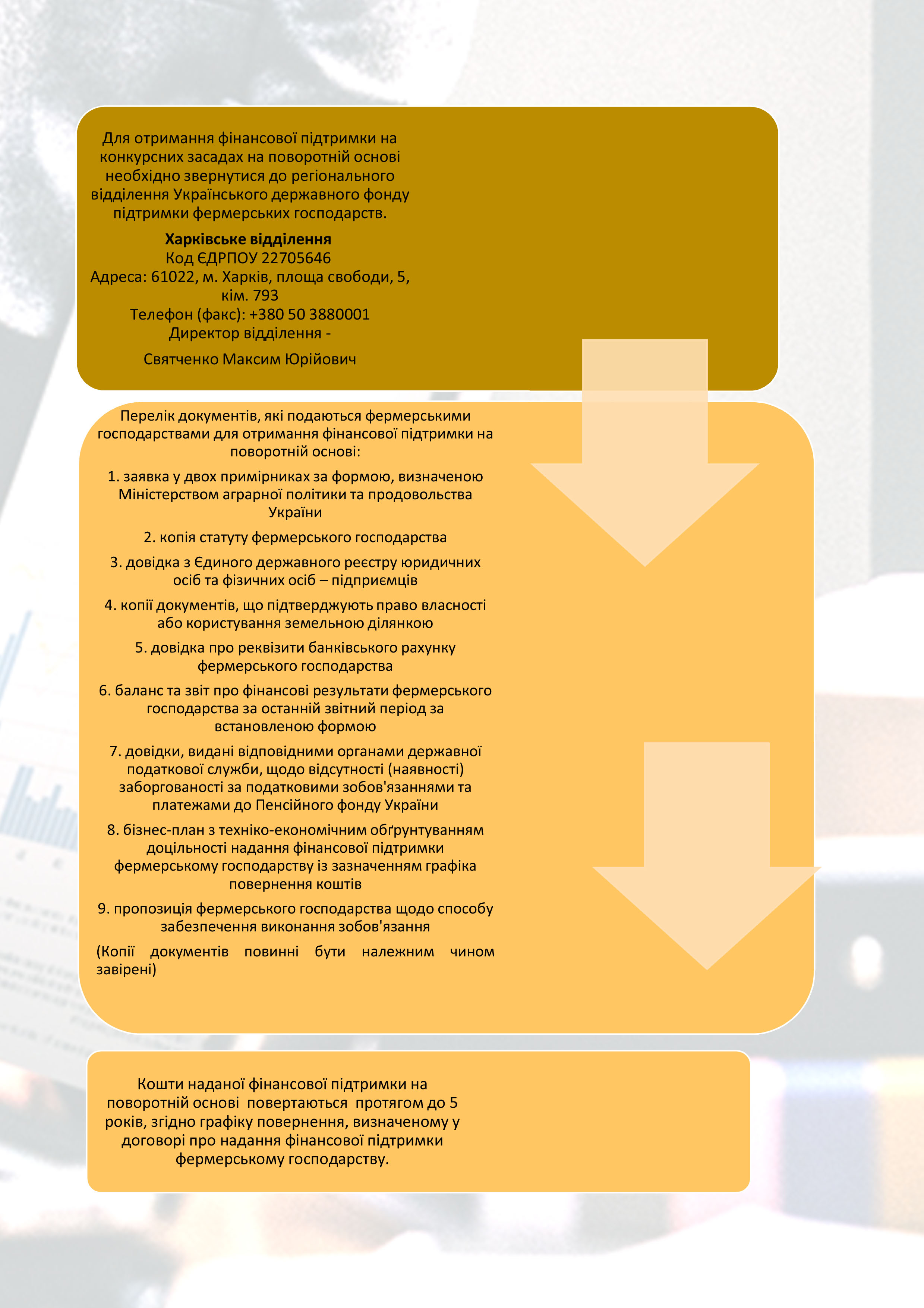
Overview of farm support and development programs

According to Article 10 of the Law of Ukraine of 19.06.2003 No. 973 «On Farming» assistance to farms is provided through the Ukrainian State Fund for Support of Farms, which is a state budgetary institution and performs the functions of implementation of the state policy on financial support for the establishment and development of farms .
Financial support is provided in accordance with the Procedure of using the funds provided in the state budget for support to farms, approved by the Cabinet of Ministers of Ukraine Decree No. 1102 of August 25, 2004 (hereinafter — the Procedure).
Support is provided on a recurring basis in an amount not exceeding UAH 500 thousand up to five years with collateral.
Assistance can be obtained from:
- purchase of machinery, equipment;
- renewal of working capital, including for the purchase of royal stock of farm animals (heifers, heifers, cows, sows, bright, ewes, goats and goats);
- carrying out conformity assessment of production of organic products (raw materials);
- production and processing of agricultural products;
- construction and reconstruction of industrial and non-industrial premises;
- for laying perennial plantations;
- development of credit and service cooperatives, including for payment of share contributions to unit funds of agricultural servicing cooperatives established by the farms alone or together with members of private peasant farms;
- irrigation and land reclamation.
On equal terms, preference is given to farmers who:
- are members of an agricultural service cooperative;
- carry out cattle breeding and breeding activities;
- have cultivated parcels of land not exceeding 500 hectares;
- young fruit and grape plantations are planted;
- applied for the transition to the production of organic products (raw materials).
The UkrSERF brings to its regional offices the amounts of allocated budgetary funds and works to conduct a competition among farmers — applicants for financial support.
Financial support is provided on a competitive basis:
- newly established farms and
- farms with separate farms,
- v farms that conduct business and are located in mountain settlements, in the Polish territories, the period of
- providing financial support from three years to three years for production, processing and marketing of manufactured products, production activities;
- v to other farms A period
- of financial assistance up to five years.
Financial support on a competitive basis on a rotary basis is provided in the amount not exceeding 500 thousand hryvnias, ensuring the fulfillment of the obligation to repay budgetary funds. The competition announcement is published in the print media (the name of the newspaper / publication can be found in the regional offices of the Foundation). The documents for participation in the competition are accepted not less than within 30 calendar days from the moment of publication.
For Kharkiv, the amount of financial support for farms on a turnaround basis amounted to 2 671 500 UAH in 2016 .
The regional commissions register and verify the submitted documents and, if appropriate, register the farm in the logbook of registration of the farms applying for financial support, and include them in the register of farms applying for financial support.
The regional commission consists of two representatives of structural divisions of regional state administrations, which provides the functions on agro-industrial development, two representatives of regional branches of the Ukrainian State Fund for Support of Farms, one representative of the territorial body of the State Financial Inspectorate, five representatives of the regional representative office of the Organization of Farmers’ Organizations of private landowners of Ukraine », which are recommended by the Council of AFSU and do not have overdue debts A Ukrderzhfondom one representative from GS «Agrarian Union of Ukraine» organization «Union of agricultural service cooperatives members,» National Association of Agricultural Advisory Services of Ukraine and the Organic Federation of Ukraine.
Features of taxation of farms
Newly formed agricultural producers — legal entities may be taxpayers of the fourth group tax from the following year if the share of agricultural production received in the previous tax (reporting) year equals or exceeds 75%. The previous tax (reporting) year for newly established agricu
Newly formed agricultural producers — legal entities may be taxpayers of the fourth group tax from the following year if the share of agricultural production received in the previous tax (reporting) year equals or exceeds 75%. The previous tax (reporting) year for newly established agricultural producers of legal entities is the period from the date of state registration to December 31 of the same year.
ltural producers of legal entities is the period from the date of state registration to December 31 of the same year.
The submission of the general and reporting single tax taxes of the fourth group with appendices not later than February 20 is the basis for considering the possibility of transition of the agricultural producer to the simplified system of taxation and registration by the payer of the single tax of the fourth group.
The decision to include an agricultural commodity producer in the Register of single tax payers of the fourth group is made after the verification of compliance with the above requirements for the election of the simplified system, as well as a chamber check of the submitted tax declarations from the single tax of the fourth group, the term of which is stipulated by clause 76.3 of Art. 76 PKU and is thirty calendar days.
The controlling body at the place (location) of the legal entity shall provide a written reasoned refusal to register a single tax payer of the fourth group and to include in the Register of taxpayers a single tax of the fourth group within thirty calendar days after the last day of the tax filing date.
Failure to submit a report —
300 SIPO sizes * Non-declaration
(non-inclusion) of information submitted in the Report on all completed during the reporting period —
1% of the amount of CAs not declared in the submitted Report, but not more than 300 NMPs Reporting
(clarifying report) after 30 calendar days following the last day of the deadline for payment of fines (fines) as defined in p. 120.3 CLE —
5 PMPO size for each calendar day of failure to report (specifying report)
late reporting —
1 PMPO size for each calendar day late submissions I report, but not more than 300 sizes PMPO
Late KO declaration submitted a report specifying when submitting reports —
1 amount of MIPO for each calendar day of untimely declaration of CA in the submitted Report on CA in case of submission of a clarifying Report, but not more than 300 sizes of MCO
* MCO — subsistence minimum for able-bodied person on January 1 of the tax (reporting) year.
The documents and information required for tax control of the shopping mall should be kept for 7 years (2555 days) from the date of filing the tax statements for which the documents are used (corporate income tax declaration. CA report).
In addition, the following information should be disclosed:
1.Data about the person who is a party to the controlled transaction and related persons of the taxpayer who owns his corporate rights and corporate rights owned by the payer himself.
2.Description of the taxpayer’s management structure, the scheme of its organizational structure, indicating the total number of employees and by section of the company.
The financial performance data used in calculating the profitability of the CA should be supported by the financial and accounting records of the taxpayer or its counterparty (depending on the party to the controlled transaction being investigated)
It is determined by the Resolution of the Cabinet of Ministers of Ukraine from 04.07.2017 No. 480.
Changes to the list of OPF come into force from January 1 of the reporting year following the calendar year in which changes were made to the list. From 01.01.2018 the scope of the List of OPF, except Art. 39 PKU, extended to uncontrolled operations in the cases defined by Art. 140.5.4 clause 140.5 p.140 PKU.
According to the Law of Ukraine of 10.14.2014 p. Number 1702-VII «On prevention and counteraction to legalization (laundering) of proceeds from crime, terrorist financing and the financing of proliferation of weapons of mass destruction»:
— an individual who, regardless of formal ownership is able to decisive influence on the management or economic activity of a legal entity, directly or through others;
— the ultimate beneficial owner (controller) may not be a person who has a formal right to 25% or more of the share capital or voting rights of a legal entity, but is an agent, nominal holder (nominal owner) or is only an intermediary in such a right;
— Article.641 of the Commercial Code of Ukraine obliges enterprises to establish their final beneficial owner (controller) to regularly update and store information about it and to provide it to the state registrar.
The tax payer’s tax liability in the CA is calculated to a price (profitability indicator) equal to the median of that range.
The adjustment rule:
1) may be implemented provided that this does not lead to a reduction in the amount of tax payable to the budget;
2) the price is adjusted in controlled transactions even if such price differs from the actual price set during the controlled operation;
3) the taxpayer is not entitled to self-correction during the TCU audits.
The procedure for calculating the price range (profitability) and the median of such a range for transfer pricing purposes was approved by CMU Resolution No. 381 of 04.06.2015.
Taxation in the field of trade and food, innovations in 2019
According to paragraph 3 of Art. 291.5.1 NKU according as amended by the Law number 2628 from 01.01.2019 to natural persons on a single tax, allowed to retail cider and perry, without the addition of alcohol.
From 01.01.2019, entrepreneurs who are on a single tax and retail sales of medicines and medical products, regardless of the amount of sales revenue per year are required to apply PPO. However, it should be noted that the legislator does not clearly define what to refer to as «medical devices».
According to item 21 of the Procedure of conducting trading activities and rules of trading service on the consumer goods market, CMU Resolution No. 833 dated 15.06.2006, economic entities engaged in activity in the field of sale of goods, catering must establish special means of payment (payment terminals ).
- carry out trading activities in settlements with a population of 25 thousand or more;
- in accordance with the law, registrars of settlement operations use.
According to item 1 of the Decree “On settlement of goods sold (services rendered) using special payment means” dated 29.09.2010 No. 878, economic entities, in particular small and micro-enterprises are obliged to accept special payment means for settlement sold goods (services provided) if they simultaneously meet the following requirements:
According to the letter of the Ministry of Economic Development of Ukraine dated May 7, 2013 No. 3502-06 / 16081-12 and the letter of the Ministry of Economic Development of Ukraine dated April 29, 2013, No. 2397/5 / 99-99-18-05-16 , there is no obligation to use electronic means of payment to pay for goods sold (services rendered) by non-PPO entities.
However, not all entrepreneurs are exempted from PPOs, since the first group of such persons were initially sellers of technically sophisticated household goods subject to warranty repair, and from 2019 — medicines and medical products.
In case of excess of over UAH 1 000 000 in the calendar year, the application of PPO for such single tax payer of the second, third group (individual — entrepreneur) shall be obligatory from the first day of the first month of the quarter following such excess.
However, the use of PPOs is optional if payment for the goods (services) under the contract is made exclusively in non-cash form through the bank’s institutions.
If at the same time at the economic object of an individual entrepreneur are sold both goods which are to be sold with obligatory use of PPO (eg medicines) and any other goods, then it is duly registered and translated into fiscal PPO regime. should be used during the sale of all goods available on the farm.
When making non-cash payments for goods and services with payment cards or payment systems using the Internet, business entities are obliged to apply PPO accordingly. In this case, when selling goods and services over the Internet, settlement documents are provided directly to the consumer at the time of handing over the goods or services. The settlement document must specify the form of payment by cash, electronic payment, credit, etc.
At the same time, in the case of payments between non-cash entities through the banks’ institutions from the settlement account of the entity receiving the goods, works (services), into the settlement account of the supplier of goods, works (services) according to the invoice, contract etc., PPO does not apply.
Business entities engaged in cash and / or non-cash payment transactions (using payment cards, payment checks, tokens, etc.) for the sale of goods (services) in the field of trade, catering and services, as well as cash collection operations for its further transfer in accordance with item 12 of Art. 3 of the Law on PPO, obliged to keep in accordance with the procedure established by law, inventory inventory in warehouses and / or at the place of their sale, to sell only those goods (services), which are reflected in such accounting.
For violation of the procedure established by law for settlements in the sphere of trade, catering and services, the responsibility of the administrative procedure, determined by Art. 1551 of the Administrative Code, which is applied in the form of imposition of a fine on persons carrying out settlement operations, from two to five non-taxable minimum income of citizens (34 — 85 UAH) and on officials — from five to 10 non-taxable minimum income of citizens (85 — 170 UAH).
Failure to comply with the provisions of the order of keeping inventory of goods in warehouses and / or at the place of their realization in the order established by the legislation according to item 12 of Art. 3 of the Law on PPO, leads to the drawing up of the protocol on an administrative offense for the person guilty of this action and is the responsible person, who is entrusted with the obligation to keep inventory, and is issued a fine in the amount specified above. This may also be the basis for the appointment of an unscheduled audit by the supervisory authority.
Features of the organization of trading activities and food
Pursuant to the Law of Ukraine «On Consumer Protection» of 12.05.91, № 1023-XII and item 15 of Art. 3, item 6 of Art. 9 of the Law of Ukraine «On the use of registrars of settlement transactions in the sphere of trade, catering and services» of 06.07.95 № 265/95-ВР economic entities carrying out settlement transactions in cash and / or non-cash form (using payment cards, payment checks, tokens, etc.) for the sale of goods (provision of services) in the sphere of trade, catering and services, as well as operations for accepting cash for its further transfer, are obliged to provide the buyer of goods (services) with his check, invoice upon his request and because it is another written document certifying the transfer of title to them from seller to buyer in order to fulfill the requirements.
Cash on hand must be posted on the day the cash is received in full.
Posting cash at the cash desks of institutions / enterprises and their separate subdivisions, which carry out cash payments with their cash orders and keeping a cash book, is to record cash in the full amount of its actual cash receipts on the basis of profitable cash orders.
Posting cash at the cash desks of natural persons-entrepreneurs who make cash payments with the registration of their commodity checks (receipts) and keeping a book of income and expenses (or book of accounting of income), is the implementation of cash accounting in the full amount of its actual income in the book of accounting of income and expenses (or book of accounting of income) on the basis of commodity checks (receipts).
Posting cash at the cash desks of separate divisions of establishments / enterprises, as well as at the cash desks of individuals-entrepreneurs who conduct cash payments using PPO and / or BOR without conducting a cash book, is to carry out cash accounting in the full amount of its actual receipts based on the data of the settlement documents by forming and printing fiscal reporting checks and pasting them on the relevant pages of the CRC or by entering the settlement receipts into the CRC.
Business entities that conduct cash payments using PPOs and / or CRFs use CRFs to:
1) paste and store fiscal reporting checks on the respective CRF pages;
2) carrying out operations with payment receipts in case of failure of PPO or power outage;
3) accounting for repairs, maintenance work, structural inspections and PPO software.
In this case, the document certifying the receipt of the proceeds to the bank and confirming the cash advance at the cash desk of the business entities is:
1) a receipt to the bank’s profit document for cash depositing, signed by the responsible persons of the bank and certified by the bank’s seal;
2) a receipt (check) of an ATM or software-technical complex of self-service;
3) a copy of the accompanying information to the bag with cash proceeds (cash), certified by the signature and the seal of the collector-collector;
4) check of payment terminal in case of cash collection in real time with the use of payment terminals.
Basic principles of the state policy on regulation of production, export, import, wholesale and retail trade in ethyl alcohol, cognac and fruit alcohol, rectified ethyl alcohol of grape alcohol, ethyl alcohol of rectified fruit, distillate of grape alcohol, alcohol and raw alcohol, high quality and protection of health of citizens, as well as increasing the fight against illegal production and circulation of alcoholic beverages and tobacco in the territory of Ukraine akonom Ukraine «On state regulation of production and turnover of ethyl, cognac and fruit, alcoholic beverages and tobacco products» dated December 19, 1995 number 481.
In places of trade in alcoholic beverages and tobacco in accordance with Art. 1 of Law No. 481 must be a cash register or a book of accounts.
The Decree of the Cabinet of Ministers of Ukraine “On ensuring implementation of August 13, 2000 No. 1336 and“ On amendments to the resolution of the Cabinet of Ministers of Ukraine of August 23, 2000 No. 1336 ”of December 18, 2017 No. 984 set out a list of individual forms and conditions of activity in trade, catering and services that are allowed to carry out settlement operations without the use of cash registers using settlement books.
Retailers of bottles and cans may not retail under the aforementioned CMU Regulations, provided that no other excise goods are sold, entrepreneurs, including those under the single taxation system, without using cash registers using books of account. Also, business entities that perform cash and / or non-cash transactions (using payment cards, payment checks, tokens, etc.) are required to use PPO when selling table wines.
According to Art. 153 of the Law «On state regulation of production and circulation of alcohol of ethyl, cognac and fruit, alcoholic beverages and tobacco» of December 19, 1995 № 481 and item 22 of the Rules of retail trade in alcoholic beverages, approved by decree No. 854, sale of alcoholic beverages for bottling for Consumption on the spot is carried out only by restaurants and specialized departments of enterprises having the status of restaurants, enterprises with a universal assortment of goods. In the text of the said Rules, the words «catering company» are replaced by the words «restaurant establishment» in accordance with Resolution No. 924.
The table wines are sold without the use of PPOs with the use of RK and KROO.
The sale of wines with the addition of alcohol (wine-processed) grapes of their own production of ordinary and vintage bottling with containers with a capacity from 50 to 600 liters is allowed to the entities of primary and mixed winemaking exclusively at the location of such entities within the administrative-territorial units ( cities, towns, villages) with payment of excise tax in the amount prescribed by the Tax Code, if the license for retail sale of alcoholic beverages has an appropriate record of the issuing authority. tsenziyu.
The annual sales volumes of wines (wine-treated materials) for bottling by such entities may not exceed 20% of the annual volume of wine produced.
During the mass events, village, town and city councils within the respective administrative territory may prohibit or restrict the sale of beer (except beer in plastic containers), alcoholic, low alcohol and table wines.
The subject of management of the restaurant industry in the course of retail sale of products of own production (culinary dishes, flour, confectionery and bakery products, coffee, tea or chocolate) with the addition of alcoholic beverages should not be licensed for the retail trade of alcoholic beverages under the conditions of production technologies. such products specified in the regulatory documentation.
Clause 4.17 of DSTU 3297-95 “Liquor industry. Terms and definitions «provides that a cocktail (alcoholic beverage production) is a alcoholic beverage with a strength of 20 to 40% with a mass concentration of extractives from 5 to 25 g / 100 cm3, which is diluted with mineral water or fruit, berries, or soft drinks, made by mixing ready-made beverages or blending certain semi-finished products and ingredients.
It is forbidden to mix drinks of different types and brands in addition to cocktails during the sale of alcoholic beverages at the restaurant establishments. The technological, calculation cards on the cocktail are agreed with the sanitary-epidemiological service, approved by the head of the enterprise, the accountant and fastened with the seal (clause 23 of Regulation No. 854).
In accordance with paragraphs 25 and 26 of the aforementioned Regulation No. 854, establishments of the restaurant industry must have price lists for alcoholic beverages, specifying the name of the drink, the contents of the bottle, the price per bottle, the price for 50 and 100 ml of the drink in the currency of Ukraine. Alcoholic beverages are signed by the head and accountant of the business entity, are affixed to the seal and must be accessible to the consumer.
When selling alcohol the seller must give the customer settlement document established form, confirming the purchase marked the date of sale
Thus, there are two types of cocktail catering — Black & Decker products according to the flow chart its manufacturing and industrial cocktail .
Taking into account the above, the establishments of the restaurant industry and specialized departments of the enterprises having the status of establishments of the restaurant economy, the enterprises with the universal assortment of the goods for the sale of cocktails with the use of alcoholic beverages should be licensed for the right of retail trade in alcoholic beverages.
Subparagraph 14.1.5 of clause 14.1 of Art. 14 of the Tax Code stipulates that alcoholic beverages are a product obtained by alcoholic fermentation of sugar-containing materials or made on the basis of food alcohols with an alcohol content of more than 0.5% by volume of ethyl alcohol, which are indicated in headings 2203, 2204, 2205, 2206, 2208 according to UED FEA, as well as with an ethyl alcohol content of 8.5% by volume or more, which are indicated in heading 2103 90 30 00, 2106 90 according to UED FEA. According to the Explanatory Note to the FEAU, approved by Order No. 401, cocktails belong to heading 2208 90 69 under the code of the FEA and are accordingly considered as excise goods.
When determining the minimum wholesale and retail prices for certain types of alcoholic beverages to the entities that carry out the sale of alcoholic beverages, it is necessary to observe the requirements of Resolution No. 957.
The minimum retail prices for alcoholic beverages are determined on the basis of the minimum wholesale and selling prices for these products and trade allowance.
Minimum wholesale prices for alcoholic beverages, which are determined by the codes of products of UKT FEA for 1 liter of 100% alcohol, calculated on the basis of the lowest wholesale price for domestic or contract value for imported products and taxes and fees, which are subject to applicable legislation units of production by domestic manufacturers and importers, and taking into account the cost of packaging.
In the event of failure of the PPO, the entity is obliged to act in accordance with Section 4, Section 4, of the PPO Registration Procedure. In particular, an entity using a PPO shall be obliged to notify the CCA in the event of a PPO failure, as well as damage to the controls during the working day, when a fault or damage is detected, in writing or by electronic means. two working days after the date of detection of the defect or damage in writing or by electronic means in an arbitrary form, notify the controlling authority where the entity is registered as a taxpayer.
Paragraph 10 of the said section stipulates that for the period of failure of PPO or in case of power outage, the settlement operations shall be carried out with the use of CRT and LCD.
Pursuant to Section 8, Chapter 8, Section 4, of the CORF, in the case of multiple fiscal reporting checks being printed on the PPO during the working day, they are all glued to the corresponding CORF. The entries in Section 2 of the COR are made separately for each fiscal reporting check. If the fiscal reporting check contains data on the «business entry» and «service delivery» of funds, columns 3, 4 of section 2 of the COR can not be filled.
At the same time, paragraphs 9 — 11 of the said chapter stipulate that Section 3 of the CRF registered at the PPO records the LCDs used during the power outage or during the PPO repair period.
Columns 1 — 5 are completed before using the LCD.
Columns 6 — 8 are completed prior to the start of registration of settlement operations using PPO after resumption of electricity supply or installation of PPO after repair.
If the start and end of one cycle of LCD use during power outages or during the repair period of the PPO occur on different business days, separate entries are made for each working day in section 3 of the FMC.
In this case, columns 1, 2 are filled only in the first, and column 8 only on the last day of one cycle of using the LCD.
In addition, on the basis of the payment receipts data, daily entries in section 2 are made to the entry for the first day of recording the corresponding amounts (columns 3 — 10) on the control tape from the beginning of the working day to the moment of failure of the PPO or power outage.
In the record of the fiscal check report printed after the resumption of work on the PPO, it is necessary to indicate for what previous dates the data in this fiscal check was summarized.
Section 4 of the CPR registered at PPO covers repairs, maintenance work, and design and software inspection of the PPO.
Columns 1 — 5 are completed by the person performing the repair, maintenance or inspection, columns 6 and 7 of the employee of the entity after restoration of working capacity of PPO.
In the event of a PPO failure, columns 1, 2 are completed by an employee of the entity immediately after the PPO failure.
After installing a repaired (standby) PPO or resuming electricity supply, it is necessary to make through the PPO the amounts of payments during the work with the use of LCDs, as well as according to the control tape (in case of zero memory) — during the work that preceded the failure of the PPOs. or blackouts, separately at each rate of VAT, excise tax, or other tax (levy), followed by a Z-report.
If necessary, the transaction «official deposit» for the amount of cash stored at the place of settlement is performed.
Paragraph 7 of Chapter 2 of Chapter III of the Procedure of the CRC stipulates that the amount of cash stored at the place of settlement before the beginning of the working day is paid by the business entity during the working day or is at the place of settlement at the moment of failure of the PPO or power outage. at the back of the payment receipt marked “Service Insertion”.
The amount of cash withdrawn by the business entity during the business day from the place where the payments are made shall be recorded at the back of the payment receipt marked “Service Issuance”.
Thus, in case of power failure or failure of the PPO, the cashier is obliged to fill the CRC and LCD in accordance with the above algorithm, in compliance with the requirements of the CRC Order.
Pursuant to paragraph 12 of Chapter 1 of Section II of the CRC Order, at the request of the business entity, one or more of the first CRCs can be registered for use at separate settlements. Such CSFs are registered in the DFS information system and receive a fiscal number for each CSF.
Paragraphs 3 and 7 of Chapter 4 of the said section stipulate that if a business entity in a separate business unit organizes several settlements where, in accordance with the law, it is allowed to make settlements without PPO, at the request of the entity at all settlements in such settlement one business unit can be used for one business unit.
However, in the case of using a BOR registered for a business unit, at several places of payment, daily records of the details of the payment receipts and the cash flow are made separately for each place of payment. If several RCs are used at one place during the day, the records of the account receipts and cash flow are kept for each RC separately.
Pursuant to Section 7, Section 7, of the PPO Registration Procedure, the registration of cash withdrawal in case of return of goods (refusal of service, acceptance of bail, payment of winnings to state lotteries and in other cases) or cancellation of the amount of payment incorrectly made through the PPO shall be registered by ‘ capacity amount.
If the PPO algorithm does not provide a separate accumulation of negative amounts of payments in the fiscal memory, it is allowed to register the issuance of funds (cancellation of an erroneous amount) by means of the «service issue» operation. At the same time, it is forbidden to register negative amounts through the PPO using the reversal operation.
Clause 4.1 of Regulation No. 637 stipulates that in order to ensure cash payments, businesses should have a cash desk and their managers should ensure that the cash desk is properly maintained and that cash is stored in it. If it is not the fault of the managers that the proper conditions have been created to ensure the safekeeping of the funds during their storage and transportation, they are responsible for this in accordance with the procedure established by the legislation of Ukraine.
The cashier, in accordance with the legislation of Ukraine, is fully liable for the preservation of all the values he has accepted. The cashier is forbidden to outsource the work entrusted to him.
In the case of enterprises that have one cashier, in case of temporary replacement of his duties, the cashier relies on another employee by written order of the manager. With this employee, an agreement is concluded on full liability for the time of performing his duties as a cashier.
In the absence of a cashier (due to illness, etc.), the values transferred to him under liability are transferred to another cashier to whom they are transferred, in the presence of a manager and chief accountant or in the presence of a commission appointed by the head of the enterprise. The results of the transfer and transfer of values shall be drawn up by an act signed by the said persons.
Companies whose staff list does not provide for the position of cashier, the performance of his duties may be entrusted in accordance with the written order of the manager to an accountant or other employee with whom the contract on full liability.
Therefore, if the official (manager) has created the right conditions to ensure the safekeeping of funds during their storage, then he is not responsible for cash at the cash desk. This responsibility rests with the cashier.
Pursuant to Section III, Section 6, of the Registration Procedure, the deposit or withdrawal of cash from the place of settlement must be registered through the PPO using the «business deposit» and «service delivery» operations, if such deposit or delivery is not related to the settlement operations. In addition, the «deposit service» operation is used to record the amount of cash stored at the place of settlement at the time of registration of the first settlement transaction, which is carried out after the Z-report.
That is, «business entry» and «service delivery» are not settlement operations within the meaning of the PPO Law.
In this case, the cash withdrawal from the PPO box for delivery to the bank is registered through the PPO using the «service delivery» operation. The current legislation does not prohibit such issuance during the business hours of the enterprise without resetting the PPO and provided that settlement operations will be carried out and a Z-report will be printed at the end of the work shift.
Introduction of IT technologies in modern business
According to para. 8 h. 2 tbsp. 9 of the Law of Ukraine «On Accounting and Financial Reporting in Ukraine» of July 16, 1999 No. 996-XIV and Clause 2.4, Regulation on Documentary Support of Records in Accounting, Approved by the Order of the Ministry of Finance of Ukraine dated May 24, 1995 No. 88, letters of the State Tax Service of Ukraine dated 04.01.2017, № 30/6 / 99-99-15-02-02-15, the State DFSU in the city of Kiev dated April 7, 2016, No. 2849 / K / 26-15-13-02- 15, SFSU dated 05.07.2017, № 967/6 / 99-99-15-02-02-15 / IPK, SFSU dated 03.10.2017, № 2112/6 / 99-99-14-03-03- 15 / PIC primary documents, subject to the requirements of the legislation on electronic documents and electronic document flow can be made in electronic form and, in particular:
— electronic cash instruments should be designed in accordance with the legislation of Ukraine in the electronic document;
— the company, in the presence of the certificate of the public / enhanced key, uses the electronic digital signature of the legal entity when carrying out information exchange with other subjects of electronic interaction.
Delivery of goods purchased from the sale of goods via the Internet, in the case of payments by payment cards, can be carried out, in particular, by mail and both its own courier service and a third-party courier organization under a contract with the seller.
In case of delivery of the goods by post on the condition of prepayment with the use of payment cards, the economic operator shall enclose in the postage the settlement document of the form and content established by the law for the full amount of the performed transaction, confirming the fact of purchase and sale of the goods, stating in the cash receipt «prepayment of goods »Or in the case of deferred payments — conducted through PPOs using the pre-programming mode of» loan repayment «. In this case, the printout of the settlement document for the PPO is performed on the basis of an extract from a financial institution.
In the case of the sale of goods for which a warranty period is set, also a technical passport or other document replacing it, which must make a note of the date of sale and the name of the business entity, which is stamped (stamped) and signed by the subject management.
If the delivery of the goods is made by mail subject to postpay, at the moment of receipt of the goods in the post office the buyer pays the funds for transfer to the bank account of the seller. The relevant document confirming the fact of payment of the goods, in this case is obliged to issue a post office. The document certifying the receipt of a product will be the bill of sale of the seller, invested by the entity (seller) in the parcel.
In the case of delivery of goods by courier service subject to prepayment using the above payment cards in the same way as in the case of delivery of goods by mail: the seller must ensure delivery to the buyer of the previously printed settlement document (check) together with the purchased goods and properly executed warranty card.
If the delivery of goods is carried out by the courier service on condition of postpay, the courier issues a payment document (check) to the buyer at the time of payment for the purchased goods. In this case, the settlement document (check) must be printed using the PPO registered on the vehicle being delivered.
When making payments using an electronic payment card (payment card) of a payment terminal connected or linked to a PPO, the cashier’s check must contain the required item 6 of Section II of Regulation No. 13, such as:
— Esq. details that will enable them to be identified;
— payment device identifier;
— amount of commission (if any);
— type of operation;
— requisites of electronic payment instrument (payment card) (admissible rules of payment system security), in front of which capital letters of «FTE» are printed;
— the inscription «Code of the bus.» and an authorization code or other code identifying the transaction in the payment system, except where the rules of payment system of the payment system provide for the preparation of settlement documents using electronic payment means (payment cards) without performing authorization procedures;
— signature of the cashier and signature of the holder of the electronic payment instrument (payment card) (if stipulated by the rules of the payment system) in separate lines, before which the inscriptions «Cashier» and «EPZ Holder» are printed;
— the check should indicate the form of payment — non-cash payment.